
Giống như nhiều tỉnh thành khác Hải Phòng cũng đã bắt đầu áp dụng phạt nguội thông qua hệ thống camera giám sát. Hãy cùng Phạt Nguội khám phá các điểm lắp camera ở Hải Phòng và tìm hiểu cách xử lý khi bạn gặp phải trường hợp vi phạm giao thông nhé!
Danh sách các điểm phạt nguội ở Hải Phòng năm 2024

Từ tháng 4/2023, Sở Giao thông Vận tải và Công an TP. Hải Phòng đã bắt đầu lắp đặt hệ thống camera phạt nguội tại 5 nút giao lớn trên địa bàn tỉnh. Danh sách các điểm phạt nguội ở Hải Phòng được cập nhật 2024 bao gồm:
- Giao nhau giữa Nguyễn Đức Cảnh – Trần Nguyên Hãn
- Giao nhau giữa Bùi Viện – Võ Nguyên Giáp
- Giao nhau giữa Tô Hiệu – Trần Nguyên Hãn (quận Lê Chân)
- Giao nhau giữa Phạm Văn Đồng – Đường 363 (huyện Kiến Thụy)
- Giao nhau giữa Phan Đăng Lưu – Hoàng Quốc Việt (quận Kiến An)
Từ ngày 1/5/2023, UBND thành phố Hải Phòng đã phối hợp với lực lượng công an để rà soát xử lý các hành vi vi phạm giao thông thông qua các điểm lắp camera phạt nguội tại Hải Phòng. Việc này nhằm tăng cường hiệu quả quản lý giao thông đảm bảo an toàn cho tất cả các phương tiện tham gia giao thông trên địa bàn thành phố.
30+ điểm lắp camera phạt nguội tại Hải Phòng từ tháng 3 năm 2025
Nằm trong dự án triển khai hệ thống hạ tầng kỹ thuật ngoại tuyến, dự kiến đầu năm 2025, Hải Phòng sẽ lắp thêm camera thông minh tại 30 nút giao thông và máy đo tốc độ tại 3 vị trí.
1. Ngã tư Lạch Tray – Nguyễn Bình;
2. Ngã tư Lạch Tray – Nguyễn Bỉnh Khiêm (cầu vượt Lạch Tray);
3. Ngã tư Lạch Tray – An Đà – Đình Đông;
4. Ngã tư Lạch Tray – Lê Lợi;
5. Ngã tư Cầu Đất – Lương Khánh Thiện;
6. Ngã tư Cầu Đất – Trần Phú;
7. Ngã tư Hoàng Văn Thụ – Quang Trung;
8. Ngã tư Hoàng Văn Thụ – Trần Quang Khải;
How 100FreeSpinsNoDeposit Explains No Deposit Bonus Mechanics to Australian Players
No deposit bonuses occupy a peculiar space in online gambling. They offer real money play without requiring an upfront financial commitment, yet the mechanics governing how they work are rarely explained with any precision on the platforms that offer them. For Australian players specifically, this creates a compounded problem: not only are the bonus structures themselves complex, but the regulatory environment surrounding online gambling in Australia adds another layer of nuance that generic international guides tend to gloss over entirely. Understanding what a no deposit bonus actually is, how wagering requirements function, what triggers forfeiture, and which game types contribute differently to playthrough — these are not trivial questions, and the answers have meaningful financial consequences for anyone who takes them seriously.
The Structural Anatomy of a No Deposit Bonus
A no deposit bonus, at its most basic, is a promotional credit extended by an operator to a player without requiring that player to fund an account first. In practice, this takes two primary forms: free spins allocated to specific slot titles, or a fixed bonus cash amount credited to a player’s account balance. The distinction matters enormously because the two types carry different risk profiles and different conversion mechanics.
Free spins no deposit offers — the variety most commonly encountered in the Australian market — assign a player a set number of spins on a designated game, typically at a fixed coin value per spin. That fixed value is determined entirely by the operator, not the player. A set of 100 free spins might be valued at $0.10 per spin, generating a maximum spin value of $10.00 in total. The winnings produced from those spins are then credited as bonus funds, not as withdrawable cash. This is the step that most players misunderstand: the spins themselves are not cash, and the winnings from spins are not automatically withdrawable cash either. They represent a starting point for a wagering cycle.
Wagering requirements — sometimes called playthrough requirements — specify how many times a player must bet the bonus amount before the resulting balance can be converted to real, withdrawable funds. A 30x wagering requirement on $10.00 in bonus winnings means the player must place $300.00 in qualifying bets before withdrawal becomes possible. The specific games that count toward this total, and at what percentage, vary by operator. Slots typically contribute 100% of each bet toward the wagering total. Table games like blackjack or roulette frequently contribute between 10% and 25%, if they contribute at all. Some operators exclude table games from wagering contribution entirely when bonus funds are active.
There is also the matter of maximum bet limits during bonus play. Most operators impose a cap — commonly between $5.00 and $8.00 per spin or per hand — while bonus funds are active. Exceeding this limit, even inadvertently, can result in the forfeiture of both the bonus and any winnings accumulated from it. This is not a hypothetical risk; it is a documented source of disputes between players and operators, and it represents one of the areas where Australian players benefit most from having access to clearly structured explanations before they begin play.
Maximum withdrawal caps are another structural feature that frequently surprises players. A no deposit bonus may carry a cap of $50.00, $100.00, or some other figure on the total amount a player can withdraw as a result of bonus play. Even if a player generates $500.00 in winnings from $10.00 in free spin credits, the operator may limit the actual withdrawal to $100.00. The remainder is forfeited. This cap is legal, it is standard practice across the industry, and it is almost always disclosed in the terms and conditions — but it is rarely highlighted in the promotional material itself.
How Australian Regulatory Context Shapes Bonus Availability
Australia’s relationship with online gambling has been shaped significantly by the Interactive Gambling Act of 2001, which was amended in 2017 through the Interactive Gambling Amendment Act. The 2017 amendments specifically targeted unlicensed offshore operators offering services to Australian residents, introducing stronger enforcement mechanisms and expanding the definition of prohibited interactive gambling services. The practical effect was a wave of offshore operators exiting the Australian market or restructuring their offerings to avoid regulatory exposure.
The Australian Communications and Media Authority (ACMA) has been active in enforcing these provisions, publishing regular lists of non-compliant operators and working with internet service providers to block access to unlicensed sites. Between 2019 and 2023, ACMA actioned hundreds of complaints and directed ISPs to block dozens of offshore gambling websites. This enforcement activity has real implications for no deposit bonus availability: many of the operators most aggressive in offering these promotions operate without Australian licenses, meaning Australian players who access them are doing so outside the protections of domestic regulation.
Licensed operators in Australia — those holding licenses from state and territory regulators — are subject to responsible gambling requirements that include restrictions on certain promotional practices. The National Consumer Protection Framework for Online Wagering, which came into effect progressively from 2019 onward, introduced measures including a prohibition on credit betting, restrictions on inducements to bet, and requirements around self-exclusion mechanisms. The inducement restrictions, in particular, affect how licensed operators can market bonus offers to Australian players, which is part of why the most elaborate no deposit bonus structures tend to come from offshore platforms rather than domestically licensed ones.
This creates a genuine tension for Australian players. The most generous no deposit offers are typically available only from operators who are not licensed in Australia, which means players using them have limited recourse in the event of a dispute. Dispute resolution through Australian consumer protection bodies like the Australian Financial Complaints Authority (AFCA) does not extend to unlicensed offshore gambling operators. Understanding this context is essential to making informed decisions about which platforms to engage with, and resources that explain the mechanics of these offers in the context of Australian regulation serve a genuinely useful function. The information compiled at 100FreeSpinsNoDeposit.com reflects this dual focus — explaining both the mechanical structure of free spin bonuses and the regulatory environment in which Australian players encounter them, which is a more useful combination than either topic addressed in isolation.
The Northern Territory Racing Commission and the Australian Capital Territory Gambling and Racing Commission are among the domestic licensing bodies that issue licenses to online operators. However, the scope of what these licenses permit is narrower than what many players assume. A Northern Territory license, for instance, permits sports betting and racing wagering but has historically been interpreted as not covering online casino-style games for Australian residents. This distinction is part of why the Australian online casino market has been dominated by offshore operators rather than domestically licensed ones, and it is directly relevant to understanding why no deposit casino bonuses exist in a regulatory grey area for Australian players.
Wagering Mathematics and Realistic Conversion Rates
The probability of successfully converting a no deposit bonus into a withdrawable amount is a function of several interacting variables: the size of the bonus, the wagering requirement multiplier, the house edge of the games being played, the maximum bet limit, and the maximum withdrawal cap. Working through the mathematics with concrete numbers reveals why conversion rates are low and why understanding the structure in advance changes how a player should approach the bonus.
Consider a standard offer: 100 free spins on a designated slot game, with each spin valued at $0.10, producing a maximum bonus credit of $10.00, subject to a 40x wagering requirement and a $100.00 maximum withdrawal. To complete wagering, the player must cycle $400.00 through qualifying games. The house edge on a typical online slot sits between 3% and 6%, depending on the game’s return-to-player (RTP) percentage. A game with a 96% RTP carries a 4% house edge. Over $400.00 in wagering at a 4% house edge, the expected loss is $16.00. Since the player started with only $10.00 in bonus funds, the expected outcome is that the bonus balance will be exhausted before wagering is complete in the majority of cases.
This does not mean the bonus has zero value — variance in slot outcomes means some players will run above expectation and complete wagering successfully. But the mathematical expectation is negative, and the player who understands this is in a better position than one who believes the bonus represents free money with no strings attached. The value of the bonus, properly understood, is the entertainment it provides and the small probability of a positive outcome, not a reliable path to profit.
Volatility interacts with this calculation in a non-obvious way. High volatility slots — those with infrequent but large payouts — carry greater risk of bonus balance depletion during wagering but also offer a higher ceiling if a significant win occurs during the wagering period. Low volatility slots offer more consistent small wins that help sustain the balance through wagering but are less likely to produce the kind of large win that makes the bonus genuinely valuable. The choice of game, where the operator permits choice, is not arbitrary — it has a direct effect on the distribution of outcomes.
Maximum bet restrictions during wagering also affect strategy. If the operator caps bets at $5.00 per spin and the player is using a slot with a maximum win multiplier of 1,000x, the maximum possible win from a single spin is $5,000.00 — but this is constrained by the withdrawal cap. If the withdrawal cap is $100.00, the practical upside is limited regardless of in-game outcomes. Players who understand this in advance can calibrate their expectations accordingly rather than experiencing the cap as an unexpected restriction after the fact.
Time limits add a further constraint. Most no deposit bonuses carry an expiration period — commonly between 7 and 30 days from activation — within which wagering must be completed. Bonus funds not converted within this window are forfeited. For players who engage with online gambling infrequently, this creates a scenario where the bonus expires before wagering is complete regardless of the player’s bankroll management. Awareness of the expiration timeline at the point of activation, not after the fact, is what allows a player to make a realistic assessment of whether completing wagering within the available time is feasible.
Verification Requirements and Withdrawal Processing for Australian Players
The process of actually withdrawing winnings from a no deposit bonus involves compliance steps that are frequently underestimated. Know Your Customer (KYC) verification is a standard requirement across virtually all operators, licensed or otherwise, and it must typically be completed before any withdrawal is processed. For Australian players, this means submitting government-issued identification — a passport or driver’s licence — along with proof of address documentation such as a utility bill or bank statement dated within the last three months.
The timing of KYC verification matters. Some operators require verification before a player can make their first withdrawal but do not require it to begin play. This means a player can complete wagering and accumulate a withdrawable balance without having submitted verification documents, then encounter a delay of several business days while documents are reviewed before funds are released. Other operators require verification before any withdrawal request can even be submitted. Understanding which model an operator uses affects how a player should sequence their account setup activities.
Payment method restrictions are another practical consideration. Many operators restrict the payment methods available for withdrawals when a no deposit bonus has been used, particularly for the first withdrawal. Bank transfers, credit cards, and certain e-wallet services may be treated differently in terms of processing times and applicable fees. Australian players should also be aware that some payment processors apply their own restrictions to gambling-related transactions, independent of the operator’s policies — a reality that became more pronounced after several major Australian banks implemented voluntary restrictions on credit card gambling transactions in 2019 and 2020.
Cryptocurrency withdrawals have become increasingly common as an alternative, particularly among offshore operators targeting the Australian market. Bitcoin, Ethereum, and stablecoins like USDT are offered as withdrawal options by a growing number of platforms, and they generally carry faster processing times than bank transfers. However, they introduce currency conversion considerations and the volatility risk associated with holding cryptocurrency, even briefly, during the conversion process. For players unfamiliar with cryptocurrency mechanics, this adds a layer of complexity that should be understood before selecting it as a withdrawal method.
Responsible gambling tools — deposit limits, session time limits, cooling-off periods, and self-exclusion mechanisms — are available on most licensed platforms and some unlicensed ones. Australian players who find themselves engaging with offshore operators outside domestic regulatory protection should be aware that self-exclusion through GamStop (the UK’s national self-exclusion scheme) does not cover Australian-licensed or offshore operators serving Australia. The national self-exclusion register in Australia, operated through state and territory gambling help services, covers licensed domestic operators but has more limited reach over offshore platforms. This is a meaningful gap in the consumer protection framework that players should factor into their decisions about which platforms to use.
No deposit bonuses are not inherently deceptive, but they are structured in ways that systematically favour operators, and the gap between how they are marketed and how they actually function is wide enough to cause genuine financial misunderstanding for players who engage with them without a clear grasp of the mechanics. The value in detailed, technically accurate explanations of these structures lies precisely in closing that gap — not to discourage participation, but to ensure that participation is based on accurate information rather than promotional framing. For Australian players navigating an online casino market that is simultaneously heavily regulated in some respects and largely unregulated in others, that kind of structural clarity is a practical resource rather than an abstract one.
9. Ngã tư Hoàng Văn Thụ – Điện Biên Phủ;
10. Ngã tư Hoàng Văn Thụ – Nguyễn Tri Phương;
11. Ngã tư Mê Linh – Nguyễn Đức Cảnh;
12. Ngã tư Mê Linh – Hai Bà Trưng;
13. Ngã tư Mê Linh – Tô Hiệu;
14. Ngã tư Tô Hiệu – Cát Cụt;
15. Ngã tư Tô Hiệu – Trần Nguyên Hãn (đã triển khai);
16. Ngã tư Nguyễn Đức Cảnh – Trần Nguyên Hãn (đã triển khai);
17. Ngã tư Nguyễn Văn Linh – Võ Nguyên Giáp;
18. Vòng xuyến Võ Nguyên Giáp – Bùi Viện (đã triển khai);
19. Ngã tư Lê Hồng Phong – Nguyễn Bỉnh Khiêm;
20. Ngã tư Trần Nguyên Hãn – Nguyễn Công Hòa;
21. Ngã tư Trần Phú – Điện Biên Phủ;
22. Ngã tư Đường tỉnh 353 – Đường tỉnh 363 (đã triển khai);
23. Ngã ba Tôn Đức Thắng – Hùng Vương (Ngã 3 Sở Dầu)
24. Ngã ba Lê Thánh Tông – Đà Nẵng;
25. Ngã tư Cổng khu công nghiệp VSIP đường tỉnh 359;
26. Ngã tư Đường tỉnh 351 – Nguyễn Trường Tộ;
27. Ngã tư Trường Chinh – Nguyễn Trường Tộ;
28. Ngã tư Phan Đăng Lưu – Hoàng Quốc Việt (đã triển khai);
29. Ngã tư Lê Lai – Lê Thánh Tông;
30. Ngã ba Đường Liên phường – Bùi Viện.
3 điểm dự kiến lắp máy đo tốc độ:
- Phạm Văn Đồng (đoạn phường Hợp Đức, quận Đồ Sơn)
- Hùng Vương (đoạn phường Hùng Vương, quận Hồng Bàng)
- Đường tỉnh 360 (đoạn Trung tâm đào tạo sát hạch lái xe – Trường Cao đẳng nghề số 3)
(Theo nguồn tin Báo Công thương)
Cách tra cứu khi bị phạt nguội Hải Phòng
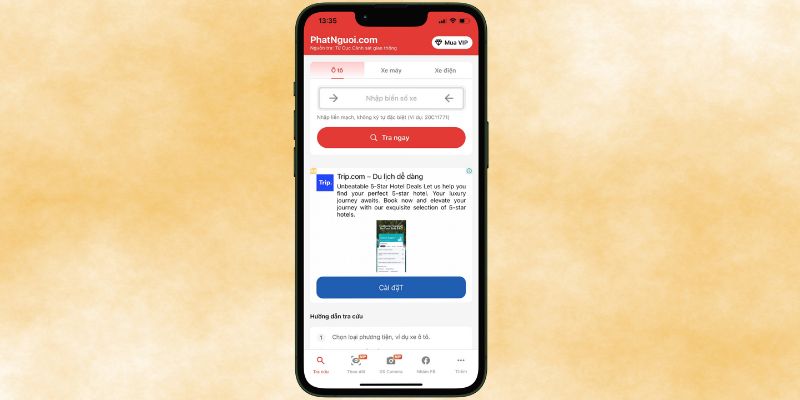
Ngoài việc biết các điểm phạt nguội ở Hải Phòng bạn cũng nên tìm hiểu cách tra cứu nghi ngờ mắc lỗi vi phạm. Khi bị phạt nguội tại Hải Phòng, bạn có thể tra cứu thông tin qua nhiều phương tiện khác nhau để xác minh tình trạng vi phạm. Hiện nay, ứng dụng “Tra cứu phạt nguội toàn quốc” đang được rất nhiều chủ xe lựa chọn sử dụng. Để tra cứu bạn làm theo các bước sau:
- Bước 1: Tải xuống ứng dụng “Tra cứu phạt nguội toàn quốc” về điện thoại.
- Bước 2: Trong giao diện chính của ứng dụng, chọn loại phương tiện bạn muốn tra cứu như ô tô, xe máy hoặc xe điện.
- Bước 3: Nhập biển số xe của bạn vào ô tìm kiếm. Đảm bảo nhập đúng định dạng biển số (ví dụ: 15A12345) để kết quả tra cứu chính xác.
- Bước 4: Bấm vào nút “Tra cứu” sau đó đợi một vài giây để ứng dụng xử lý hiển thị kết quả.
Bên cạnh đó, bạn cũng có thể tra cứu phạt nguội tại các trang chính chủ khác. Bao gồm:
- Website phatnguoi.com: Truy cập vào website phatnguoi.com để tra cứu thông tin vi phạm. Website này cung cấp dữ liệu cập nhật từ Cổng thông tin điện tử Cục CSGT đảm bảo thông tin hiển thị nhanh chóng, chính xác.
- Cổng thông tin CSGT: Bạn có thể truy cập vào cổng thông tin chính thức của Cục CSGT để kiểm tra phạt nguội.
- Cơ quan địa phương Hải Phòng: Liên hệ trực tiếp với các cơ quan chức năng tại Hải Phòng như Công an thành phố hoặc Sở Giao thông Vận tải để kiểm tra thông tin giải quyết các vấn đề liên quan đến phạt nguội.
Quy trình xử lý phạt nguội Hải Phòng chi tiết nhất
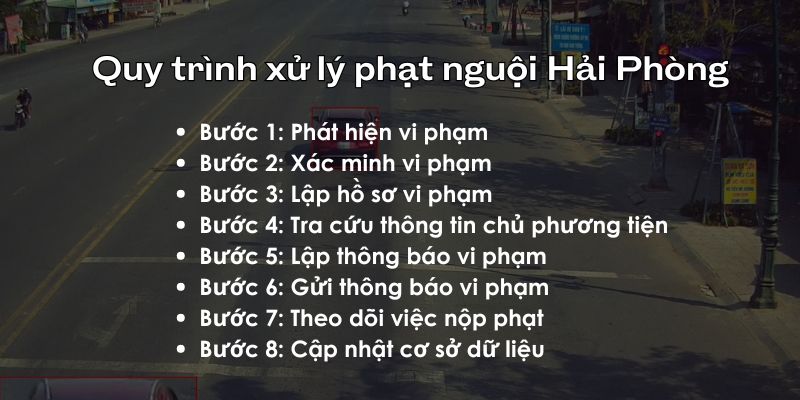
Dưới đây là quy trình xử lý phạt nguội tại Hải Phòng:
- Bước 1: Hệ thống camera giám sát tự động ghi nhận các hành vi vi phạm luật giao thông.
- Bước 2: Cán bộ chuyên trách xem xét sau đó xác minh các hình ảnh, video vi phạm.
- Bước 3: Tạo hồ sơ điện tử cho mỗi trường hợp vi phạm với các thông tin như thời gian, địa điểm, loại vi phạm, biển số xe.
- Bước 4: Kết nối với cơ sở dữ liệu đăng ký xe để xác định chủ sở hữu.
- Bước 5: Soạn thảo thông báo chi tiết về hành vi vi phạm sau đó nêu rõ mức phạt, thời hạn và phương thức nộp phạt.
- Bước 6: Gửi thông báo qua đường bưu điện đến địa chỉ chủ phương tiện.
- Bước 7: Kiểm tra để cập nhật tình trạng nộp phạt của người vi phạm.
- Bước 8: Cập nhật thông tin về việc xử lý vi phạm vào hệ thống cơ sở dữ liệu.
Như vậy, việc nắm rõ các điểm phạt nguội ở Hải Phòng sẽ giúp bạn chủ động hơn trong việc tuân thủ các quy định giao thông và hạn chế được những rủi ro không đáng có.